An Inheritance of Integrity, a Search for Meaning
“Lord, remind me every day that for me to live is Christ. Let me know that I am a God-man, because I am one with God.” Brother Huang, whose patriotic Chinese-Indonesian family was among the first to enter China at the beginning of its reform and opening up, asked a calligrapher to write these words. He had them framed and placed in his office. “This is my prayer,” he said. “I had it written out and put it up in my study to remind me every day.”
My Family Background: Integrity Handed Down
I was born in Indonesia in 1956, the seventh of eight children. When my father was nine, years of war in his hometown had made life unbearable. My grandmother took him from China all the way to Indonesia to join my grandfather, who ran a small business in Makassar. After arriving in Indonesia, my father studied diligently and did well in school. He received a good Chinese-language education, which laid a solid foundation for his future business career.
Because of the war, my father began his business travels before he had even finished high school, and he showed an extraordinary gift for business. Through more than half a century of hard work, he eventually built a vast business empire of his own, spanning many industries closely connected with people’s everyday lives.
One of my father’s most important convictions was this: before you establish yourself in the world, you must first learn how to be a person. What matters is integrity: sincerity in your heart and faithfulness to your word. With these two qualities, he believed, you could succeed no matter whom you met or what you did. Once you have given your word, you must work to keep it. Even if circumstances turn against you tomorrow, you should still do your utmost to fulfill what you promised. My father’s character and thinking were engraved on the hearts of us children; they run in our blood. This is the wealth he left us.
My father placed tremendous importance on his children’s education. Although his own schooling had been limited, he sent us to the best schools around the world. My brothers and sisters also worked very hard and were determined to do well. After we graduated, he sent us off to a small place in Indonesia to toughen us up. He wanted us to learn to survive with the fewest resources and to learn how to excel. I started on the factory floor in my father’s business and received thorough training in administration, personnel, production, and finance.
“That answer did not satisfy me. I kept searching.
Searching for Life’s Meaning: Salvation Comes to Our Family
When I was very young, I began searching for the meaning of life. I asked my father, and he answered, “The meaning of life is to build a successful business, give back to society, and make a contribution.” That answer did not satisfy me. I kept searching.
Later I went to university in Berkeley, California. Apart from doing my coursework, I spent whole days buried in the library, looking for every book I could find about the meaning of life. The Lord remembered this seeking heart of mine. In 1976, when I was twenty, I met a brother in the church. He invited several of us students to his home, just across from the meeting hall, for some refreshments. We felt such warmth there.
Later he brought us to the meetings. I remember that the first meeting was about the story of Jacob, and it matched my own experience remarkably well. The brother giving the message spoke so vividly that it seemed he was talking about me. I found it rich and compelling; I was deeply drawn to it.
Later I attended a conference in Anaheim, where Brother Lee himself spoke on Revelation. I had attended a Catholic school as a child in Indonesia, so I knew a little about the Bible, but I understood nothing about Revelation. Now, as I listened, there were seven golden lampstands, seven Spirits, seven stars… Everything was seven. I found it fascinating.
In the truths of the Bible, I found the meaning of life. I was truly touched, and a sense of satisfaction filled my heart. Before long, I took a definite step and was baptized into the Lord. After graduating and returning to Indonesia, I still often made time to travel to Singapore, gather with the saints, and enjoy the church life.
I was the first person in my family to be saved. Now both my parents have been saved, and four of us eight siblings have been saved as well. Salvation has truly come to our family!
Returning to Our Roots, Entering the Storm
Indonesia Is Our Married Home; China Is Our Birth Home
My father loved his ancestral country deeply. During the 1960s and 1970s, he sent my two eldest brothers to China for their education. It was the time of the Cultural Revolution, and they went through the most difficult years.
In the early 1970s, they returned to Indonesia and began helping my father in the business. They did very well. They understood China. My eldest brother had graduated from the mathematics department at Peking University. He was sharp and capable, with a very precise head for business figures. My second brother was skilled at building relationships and had a flair for innovation. Through his dealings with businesspeople in Indonesia, he secured many projects and developed them successfully. After returning from China, he continued to follow its economy and policies closely.
After Deng Xiaoping’s southern tour in 1992, patriotic overseas Chinese were widely invited to invest in China. We were the first family to go to China and invest as a whole family. My father often said, “Indonesia is like the home we married into; China is like the home we were born into. We should invest more in our birth home and make a greater contribution there too.” Those earnest words of my father were deeply imprinted on my heart.
At that time, although China lacked capital, it had a market, a large population, and an open-door policy that attracted funds from many overseas Chinese and other countries. That is why China underwent such tremendous changes within thirty years. My second brother, who was good with people and understood China’s circumstances, approached local governments wherever there were state-owned enterprises in the coastal cities. Officials everywhere were eager to introduce projects to him. Within two years, we acquired more than two hundred state-owned enterprises in those cities. Each employed between two thousand and ten thousand people. Once we bought them, we had to support all those employees. These were “iron rice bowl” jobs: we could not dismiss a single employee, and even those who performed poorly still had to be supported.
“Indonesia is like the home we married into; China is like the home we were born into. We should invest more in our birth home and make a greater contribution there too.
Finally, we came to our ancestral hometown. The city’s leaders were very enthusiastic and warmly urged us to invest there. In the end, we acquired the local state-owned enterprises as a package: forty-one companies in all!
God’s Mercy in the Financial Crisis
The Southeast Asian financial crisis broke out in 1997. All across Asia, companies went bankrupt and closed down; even some countries could not escape financial collapse. By God’s mercy, our company’s business remained strong and was not greatly affected. Our group concentrated on only a few kinds of business: real estate; finance, banking, and insurance; and palm oil.
Our family had Indonesia’s largest palm oil group, with five hundred thousand hectares under cultivation and operations covering refining, sales, and the whole business chain. Our market share in Indonesia ranged from 30 to 60 percent. Indonesia had a population of more than two hundred million. Previously, people had used Indonesian coconut oil. Later we produced palm oil and brought it to market, replacing most of the coconut oil. We exported the remainder and received US dollars, so the returns were substantial.
We also made paper. Once we had met Indonesia’s domestic needs, we exported everything else. Apart from the cheapest newsprint and paper for printing banknotes, we made every other kind: printing paper, computer paper, and facial tissues. We were probably Indonesia’s largest paper manufacturer too. With our exports, we became the largest in Asia after Japan. So at that time, our situation was very favorable.
From 1997 to 2000, our investments in China’s four major sectors of paper manufacturing, banking, real estate, and palm oil exceeded our investments in Indonesia! China’s market was so large, and the government offered favorable policies: “three years exempt, three years reduced”—three years without tax, followed by three years of reduced tax. Moreover, we were doing well, so many banks lined up for our investment projects and urged us to undertake more. Our projects grew larger and larger. They were all settled in US dollars, so the depreciation of the Indonesian rupiah did not affect them. It was truly marvelous: all the Lord’s grace, all the Lord’s blessing. We had entered China very early, when most companies and groups still did not know how to do so.
Every Day, Another Mercedes Gone
A Riverside Investment: Every Step a Struggle
In 1994, I visited for the first time a city I had long wished to see. As evening fell and the riverside lights came on, the grand, magnificent buildings, blending Chinese and Western styles, struck me deeply. At that moment a desire rose in my heart: in this place, which had led the prosperity and fashions of the Far East since the 1920s, I wanted a place of my own!
I knew that real estate had to be in a first-class location. And if I was going to do it, I wanted to do it on a large scale, make it strong, and make it the best. So began the search for land, the purchase, the relocation and demolition… We went through countless difficulties. The riverside site I bought covered about twenty thousand square meters. At that time, the land cost nearly US$126 million.
I needed to borrow two or three hundred million US dollars. The risk was so great that even the banks were afraid. China had only recently begun its reform and opening up, and everyone was watching and waiting. I had to approach banks all over the world: Japan, Thailand, Singapore, Indonesia, Korea, China… It took two years to bring a group of banks together and finally obtain the loan. The US dollar was strong then, and the interest rate was 10 percent. I had to pay thirty thousand US dollars a day, the price of a Mercedes at the time. Relocation and demolition were difficult and slow, with one delay after another. Every day of delay meant another Mercedes gone! Whether I was in the bathroom or asleep, the interest kept running. All that interest was on my shoulders. The weight was unimaginable! Whenever the local government could not resolve a relocation problem, it became my problem.
In 1996, we obtained the site and began excavating the foundations. The basement was three stories deep, almost eighteen meters underground. Excavating beside the river on reclaimed land was an extremely difficult engineering task. We had to go down more than seventy meters before reaching bedrock. The whole building was very tall, the risks were enormous, and the basement was unstable and swayed. These were severe challenges, almost more than one could bear. If we failed to get the basement right and water flooded in, the entire building would be lost! The project was full of dangers and difficulties.
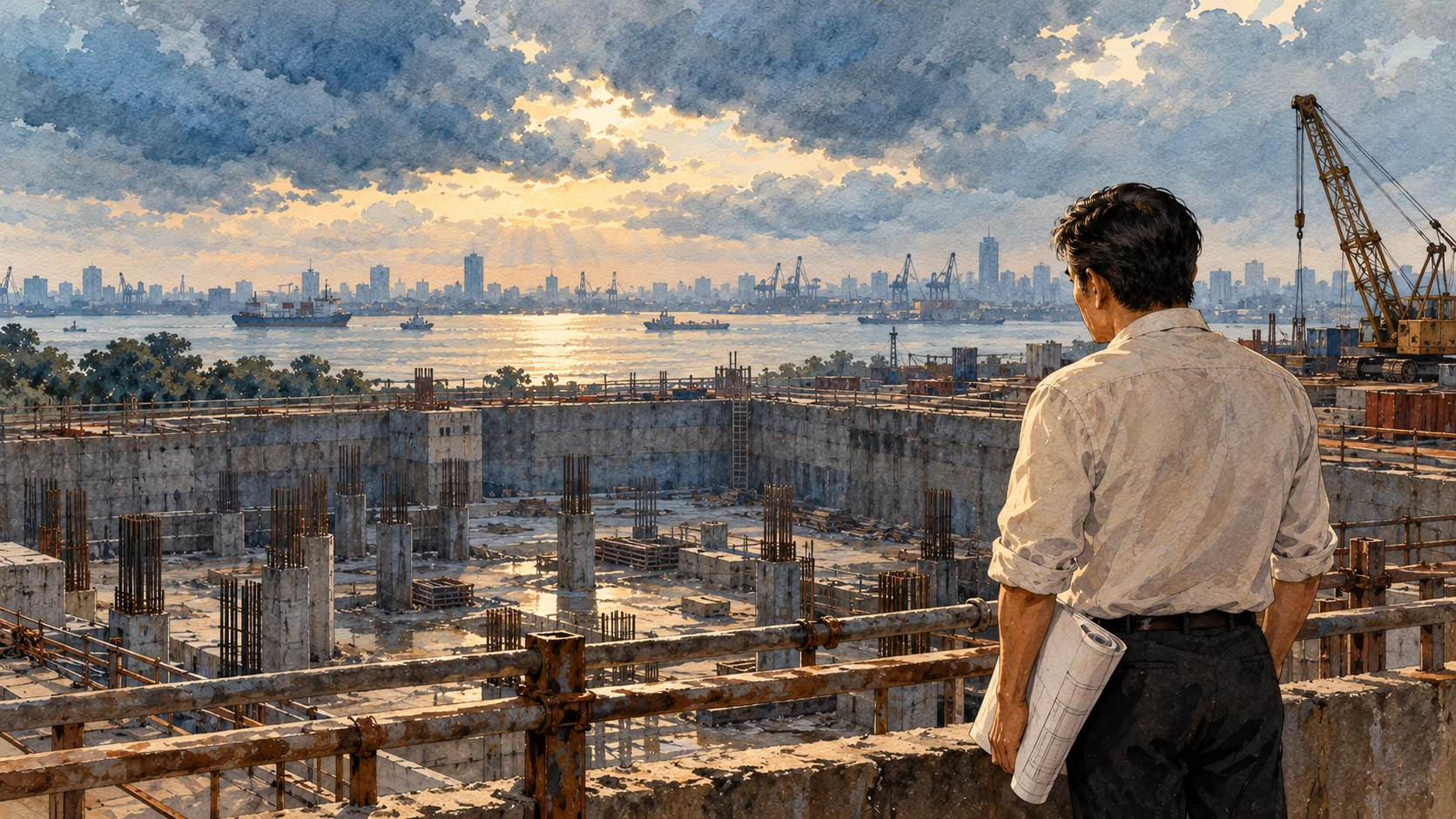
“Every day of delay meant another Mercedes gone!
Two years for relocation and demolition; two years to excavate the basement. Before we had built anything at all, I had already spent about 180 million! On top of that, I still had to pay 10 percent interest every year. We had only begun excavation in 1996 when the financial crisis broke out in 1997. Danger followed danger; every step was a struggle.
Between 1996 and 1998, we dug an enormous hole for this project. I never imagined it would become what felt like my greatest grave at that time. In a financial crisis, who would come and invest? I did not know how to go on.
As for the market, when I arrived in 1994, rent was ninety US dollars per square meter per month. By 2000 to 2002, when I was ready to build, rent had shrunk to 10 percent of that: from three dollars a day to thirty cents. Nobody wanted it; nobody was investing! Whatever I built, whatever I did, would lose money. So from 1998 to 2000, I stopped completely, waiting to see what I should build. The 180 million I had put in generated no return at all. Funding problems, financial problems, government planning problems… There were so many problems.
Then there was the planning issue. We wanted to put up the tallest building in the city, but the municipal government feared it would affect the riverside’s classical skyline. The district and municipal governments disagreed, while the central government was also exercising control. The result was that sixty-eight stories were cut to thirty-two, and one building became three. The whole process was tortuous, with many different obstacles to work through.
When I Had No Way, I Relied on the Body
Unable to Find a Way Out, Yet Not Without a Way Out
Through all these difficulties and turns, this was my spiritual experience: whenever a problem arose, I did not know how to solve it. I had no way. But I relied on the Body. Whenever something happened, I made long-distance calls to the brothers in Singapore and prayed with them. I also sought out brothers nearby. We would talk as we jogged together, and afterward I would feel that a way had opened. “We are pressed on every side but not constricted; unable to find a way out but not utterly without a way out” (2 Cor. 4:8).
In 1996, we ran into another relocation problem. I felt I simply could not carry on, so I went to fellowship with Brother Lee. He said nothing at first; he just kept smiling. I asked whether I could continue with the project. “Keep going!” he said. But how, I asked, with so many difficulties? Just then, Brother Lin had come to Anaheim and given the first demonstration of pray-reading, studying, reciting, and prophesying. Brother Lee was deeply impressed.

“If I do not touch the Lord today, I have no vitality today; if I do not have the brothers and sisters around me, I have no joy.
I said to Brother Lee, “How can I do it? It is hard for me to be a Christian, and I cannot go on with this business.” He answered, “Pray-read, study, recite, and prophesy!” That was the way he gave me: “You can do it, but you must pray-read, study, recite, and prophesy!” After I returned, I worked outwardly while inwardly I pray-read, studied, recited, and prophesied. This was my actual experience in life.
Through pray-reading, studying, reciting, and prophesying, I received the supply of the Lord’s word. I often came before Him and asked whether I should really go ahead with this project. I said, “God, if You led me here to undertake this project, You will surely complete it! If I came on my own, I certainly cannot carry it through.” I consecrated myself completely to the Lord. I came to realize deeply: if I do not touch the Lord today, I have no vitality today; if I do not have the brothers and sisters around me, I have no joy.
In 2000, the project resumed. The government finally agreed to a height of fifty stories. I sought financing again, and in the end God led a bank under the central government to support this unfinished project of mine. From 2000 to 2002, we built the structures above ground. So the entire project took four separate periods of two years.
Leaving the Experience in the Building
A Heavenly Vision, an Opening for the Gospel
When I obtained the loan in 2000, something wonderful happened: the winter and summer trainings were just then covering the New Jerusalem. So I said, “Lord, I consecrate this project to You! As I build this building, I must build within the vision of the New Jerusalem. What I do must follow the highways to Zion. I must build this ‘New Jerusalem’ well.”
The hotel I built has a distinctive three-in-one design: an office building, a hotel, and serviced apartments. Each has its own function, and they complement one another. The tallest building has the largest crown, about twenty-five meters high—the height of five stories—and fifty-three meters wide. Lit up at night, it shines brilliantly and forms a major part of the city’s nightscape. That crown is a testimony, an encouragement, and a goal. It testifies to the crown of righteousness, the crown of glory, and the crown of life spoken of in the Bible. For Christians these are a reward; for me they are also an encouragement and a goal. The meaning of the crown can also open up conversations that draw people to the gospel.
This hotel project exhausted me, yet it could still be accomplished. It was like the vision of the burning thornbush in Exodus: burning, yet not consumed. With my own ability and wisdom, I could never have done it. It was through God’s life: He is the source, inexhaustible and unfailing. We used more than four hundred pieces of hand-blown glass to create a work of art, with lights shimmering twenty-four hours a day. Like a fire that never goes out, it reminds me that only by God’s ability, God’s energy, and God’s great power can I accomplish anything. “I am able to do all things in Him who empowers me” (Phil. 4:13).
“I am able to do all things in Him who empowers me.
As you enter the hotel lobby, you see a glass ladder to heaven. This is Jacob’s dream recorded in Genesis, and it is my dream too: “a ladder set up on the earth, and its top reached to heaven; and there the angels of God were ascending and descending on it” (Gen. 28:12). The heavenly ladder is the house of God. As the ladder, Christ brings heaven—God—to earth—man—and joins earth and heaven as one. This reminds us that we are God-men.
This glass ladder has no supports; it stands on the ground entirely on its own, clear and translucent. The roof is also all glass, so you can see the sun, the stars, and the moon. It gives people a sense of being joined to heaven, a heavenly feeling.
On the carpets in every hotel corridor are Bible verses and spiritual words in cursive calligraphy: regeneration, renewing, sanctification, transformation, conformation, glorification… They encourage us Christians to live out the New Jerusalem! Some words, of course, have to be expressed subtly through art, but those who seek can find them. Another example is, “Always rejoice, unceasingly pray, in everything give thanks.” If we can practice these three things, the rest becomes easier. Because I have passed through these sufferings, I want to remember these three points and use them to encourage myself to live in this realm of being joined to heaven.
Beyond Business, a Value That Lasts
Two Kinds of Enjoyment: Investing in Eternity
The enjoyment of the Lord and the enjoyment that comes from success in business are on different levels.
Of course I want to run a good and successful business. Every one of us in business pursues that. Success gives a person a sense of achievement and satisfaction. Working hard to develop a business is an enjoyment. There is enjoyment along the way as well: striving and persevering; meeting difficulty after difficulty and challenge after challenge, and resolving each problem; bringing the business to a certain level and making a breakthrough. All these things bring enjoyment and satisfaction.
“Yet deep within my heart, what I seek is eternal and of greater value.
We should not enjoy only the destination. Enjoyment along the way is crucial. Everything is a journey: life is a journey; work, from beginning to completion, is also a journey. Every experience along that journey can become a source of satisfaction. That too is an enjoyment. What I have learned is that, whatever we do, we should not wait until we have reached the goal to enjoy it. There is much to enjoy in the process itself. If you wait until the destination, you may find yourself asking, “So what?”
This is true in business and in spiritual things as well. The difference is that in business, as you gain experience and succeed, you receive many material blessings: higher salaries, bonuses, cars, and houses. These are material things, and they have their place. But after I believed in the Lord, my understanding changed. These things are temporary. They are what people in the world pursue, and of course I pursue them in business too. Yet deep within my heart, what I seek is eternal and of greater value. However large or successful a business becomes, it is still temporary. After seventy or eighty years, or a hundred, it is gone. Eternity is what has true value. So my emphasis, my first choice, is to pursue eternity. When your center changes, your priorities change too. This is a change of understanding, with eternity as the main goal. That is why, while running a business, I spend so much time pursuing the Lord, His word, and the church life.
If a business is good, meaningful, and capable of succeeding, I invest in it seriously. I put in not only money and assets, but also energy and people. Once I see its value, I invest wholeheartedly and with all my strength. That is how it is in business. In the same way, when I see eternal value, I regard that as an investment too. This investment should have the highest priority; we should put our whole heart into it. I make every effort to set aside time for meetings and prayer, to enjoy the Lord’s word, and to do His work. I actively take part in every aspect of the Lord’s work, including caring for the needs of the churches in different places. This is the real investment: investing our money in heaven, where it has eternal value.
Taking It Up, Learning to Let It Go
With the Church as My Center, Taking Up and Letting Go
The hotel opened in 2002, with occupancy exceeding 100 percent. Guests had to book one or two months in advance. It was the city’s first five-star hotel at the time, and its best. My office building charged the highest rents locally, yet its occupancy was as high as 95 to 97 percent.
The hotel was very successful, yet I spent a great deal of time in the church life. With such a large operation, how could I be at peace? As the saying goes, one must be able both to take something up and to let it go. As an entrepreneur, without faith in the Lord, you can take it up but cannot let it go, because a business must keep expanding: if it does not advance, it falls behind.
The problems were many and difficult, and the challenges were daunting. I had poured every ounce of strength into it and devoted eight full years to the project. When it was completed, I was utterly exhausted and had no heart to start another one. Many opportunities came my way, but I turned them down one by one. Yet my center remained the church, and I still had plenty of time to pursue the Lord earnestly. What we read every day is about building up the church. Before, I had devoted myself to building this physical structure. Now I put more into building this spiritual structure, the heavenly home.
For someone in business, being able to take things up but unable to let them go is a terrible predicament. This is especially true in a large enterprise: unless you keep expanding and starting new projects, you fall behind. It is like riding a tiger and being unable to get off. But through the Lord, we can get off that tiger. I have two hotel buildings, and on one of them are these words: “I am able to do all things in Him who empowers me.” I cannot, but the Lord can. I have only one desire: to take the Lord as my center, get off the tiger, devour the tiger, and tame it!
“I cannot, but the Lord can.
One brother put it well: those of us in business who love the Lord and are fully consecrated to Him should be full-timers with a job, while the other full-timers are those without a job. Every one of us should be a priest, and a royal priest at that. A priest serves the Lord full time. Whether we have a job or not, we should all be full time. Even our employment is for supplying the church. But we must not use having a job as a reason to say we have no time. That would miss the goal entirely. Our goal is to take the Lord as our center.
In business and commerce, a realm so deeply occupied by mammon—money—God wants to gain people who live full time unto Him. They are full-time priests with a job. People in business have an enormous range of contacts and abundant resources. If they take up the burden, God can use them greatly!
E = MC²
Many entrepreneurs experience ups and downs. The ups and downs themselves are not frightening; what is frightening is being unable to get up again. There is a saying: “An overcomer is not someone who never fails, but someone who turns quickly.” In business, there will be failures, but through failure we can learn and make progress. I believe the Christian journey is like this too. As we pursue and love the Lord, we have many experiences. When we fail and feel that the Lord is not so near, we may become full of introspection, weakness, and pain. But as soon as we turn to the Lord and ask for His mercy, He brings us through again.
Hebrews tells us that the Lord Jesus is the High Priest and that He saves us to the uttermost. Often, when we fail, we feel that God may have given up on us, that perhaps we are hopeless. But these words keep reminding me: He does not save us halfway; He saves us to the uttermost! As long as we have faith in His word, a seeking heart, and can still turn to Him, God has a way to save us. Above all, our heart and spirit must be right. We should often say to the Lord, “Lord, although I am unable, I am willing to cooperate with You.” Once we have this willingness, God has a way. Even if you believe in the Lord, without that willingness His saving cannot operate in you. If you are willing, God comes in.
E = MC²: energy equals mass times the speed of light squared. E can also stand for God’s economy and for eternity, for eternal value. M can stand for Man; C for Christ, and also for Commerce. This is why Chinese businesspeople are so important. When M and the two Cs come together, they produce energy, E, like nuclear energy. And this energy has eternal value, because what is being carried out is God’s economy. The energy released is immense and eternal. A few people, wholly given for God’s economy and the gospel of the Lord’s kingdom, can produce tremendous energy and turn the age!
Living by Touching Christ
My Longing: The Hidden Manna
This year’s fall training for elders, co-workers, and responsible brothers covered the orthodoxy of the church. It was exactly forty years since I had first heard the messages on Revelation. This time I listened with great enjoyment and was deeply touched. Almost every message seemed to be spoken to me personally.
When I see the brothers, I am filled with admiration and longing, because they are full of God’s word, full of life, and one with God. They give messages, shepherd people, care for them, and help them resolve their problems, all while being full of God’s word. This is a grace, and it is my goal too. I hope that one day I can have such an experience. Although I am in business, I want to seize the opportunities to shift my energy gradually, eat more of the hidden manna, be filled more with the Lord’s word, and live out such a life, wholly one with God!
“Now I am living by touching Christ.
That is why I wrote down these words: “Let me live Christ; let me know that I am a God-man.” Looking back over my spiritual journey, I see how difficult this road has been. Often I would walk a little and then fall, so along the way I kept seeking and making progress. It feels much like China’s reform and opening up, “crossing the river by feeling for the stones.” Now I am living by touching Christ.
Dear friends, in China I learned a saying: “The road is rugged, but the future is bright.” The road is the way of the cross; the future is the glorious New Jerusalem. So I hope you will receive the Lord Jesus as your Savior and your life. As long as we have a heart that seeks God, are absolute for His interests, and seek and pursue Him, God will open a way for us, and our whole life will have eternal value.